



What is the Profit/Loss Ratio?
The profit/loss ratio (P/L ratio) is a metric used to assess the profitability of trades. It compares the amount of profit earned to the amount of loss incurred, providing a clear picture of your trading performance. A higher P/L ratio indicates more profit relative to loss, which is a positive indicator of trading efficiency.
In professional terms, while your win rate tells you how often you are correct, the P/L ratio tells you the magnitude of your success when you are right versus when you are wrong. It is the ultimate metric for separating amateur gamblers from systematic, profitable market participants. Without understanding this ratio, a trader can easily win 90% of their trades and still blow up their account if their remaining 10% of trades result in catastrophic losses. Conversely, a master trend-follower can lose 65% of their trades but remain highly profitable because their realized P/L ratio is exceptionally high.
The Importance of the Profit/Loss Ratio in Trading
In trading, the P/L ratio is vital for several reasons:
Performance Evaluation: It helps traders evaluate their strategies by showing how profitable their trades are. Rather than relying on emotional biases or remembering only your “big wins”, the P/L ratio acts as an objective, mathematical mirror. It forces you to look at the raw data of your performance over a statistically significant sample size (such as 50 to 100 trades), revealing whether your strategy possesses a true, quantifiable edge in the live market or if you are simply surviving on temporary luck.
Risk Management: A good P/L ratio can guide risk management decisions, ensuring that potential losses do not outweigh gains. By knowing your average realized P/L ratio, you can mathematically determine your exact “Risk of Ruin.” This allows you to set precise stop-loss and take-profit levels on your charts, manage your position sizing dynamically, and protect your trading capital from the devastating drawdowns that occur during inevitable market regime shifts.
Decision Making: It aids in making informed trading decisions, allowing traders to focus on strategies that yield higher profits. Instead of wasting time, cognitive energy, and capital on low-yield setups, calculating your P/L ratio across different asset classes, times of day, or setup types allows you to ruthlessly cut underperforming strategies. This statistical clarity guides you to reallocate your capital exclusively toward high-expectancy setups, maximizing your return on investment (ROI).
How to Calculate the Profit/Loss Ratio
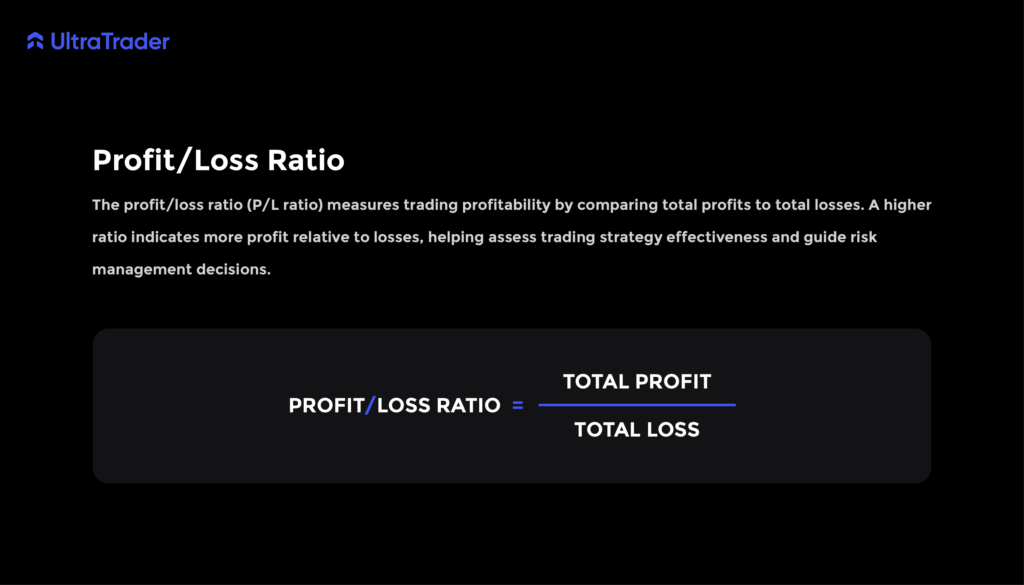
Calculating the P/L ratio involves a simple formula:
Profit/Loss Ratio = Total Profit / Total Loss
To apply this formula accurately, you must ensure you are evaluating your performance over a fixed period (e.g., weekly, monthly, or quarterly) or over a specific number of completed trades.
Total Profit: represents the sum of all gains from your winning trades within that dataset.
Total Loss: represents the sum of all losses from your losing trades within the same dataset.
Practical Example of the Profit/Loss Ratio
Let’s illustrate this with a practical example:
Total Profit: $10,000
Total Loss: $5,000
Using the P/L ratio formula:
P/L Ratio = $10,000 / $5,000 = 2
This means that for every dollar lost, two dollars were gained, indicating a profitable trading strategy.
To delve deeper, let’s consider a real-life example from a professional trading scenario. In 2019, a well-known hedge fund reported its quarterly trading results:
Total Profit: $2,000,000
Total Loss: $500,000
Applying the P/L ratio formula:
P/L Ratio = $2,000,000 / $500,000 = 4
This higher P/L ratio of 4 demonstrates that for every dollar lost, four dollars were gained. This impressive ratio reflects the hedge fund’s strategic trading decisions and effective risk management. Such a high P/L ratio is a hallmark of professional trading success, showing a significant edge in the market. This example underscores the importance of analyzing and understanding the P/L ratio to enhance trading performance and profitability.
Operational Insights into the Profit/Loss Ratio
Operationally, understanding the P/L ratio can help traders in several ways:
Strategic Adjustments: Identify which strategies are working and which aren’t. For example, you might find that your breakout strategy has a P/L ratio of 3.5:1, while your mean-reversion strategy has a ratio of 0.8:1. This operational insight allows you to halt the underperforming strategy and allocate more capital to the highly profitable breakout setups.
Risk Management: Adjust risk parameters based on the profitability of trades. If your data shows your P/L ratio is shrinking due to shifting market volatility, you can operationally reduce your position size (risk per trade) to protect your principal capital, or adjust your stop-loss placement to align with current market conditions.
Performance Tracking: Continuously monitor and evaluate trading performance for improvement. Tracking this ratio week-over-week or month-over-month allows you to spot negative behavioral patterns early such as closing winning trades too early out of fear, or letting losing trades run too long out of hope, before they cause severe damage to your account balance.
Role of P&L Trading Accounts
In trading, maintaining a consistent trading profit and loss account is essential. This account records all profits and losses from trades, providing a comprehensive view of trading activities. It’s a vital tool for calculating the P/L ratio and making informed trading decisions.
Historically, traders had to maintain these accounts using manual physical ledgers or complex, error-prone Excel spreadsheets. In today’s digital era, your trading profit and loss account must be dynamic, clean, and automated. It should serve as a single source of truth that logs entry prices, exit prices, execution times, asset classes, and specific trade setups. Having an organized, real-time P&L account is the baseline foundation required to generate the accurate data needed for deep statistical analysis.
Common Mistakes in Calculating the Profit/Loss Ratio
Traders often make mistakes when calculating the P/L ratio, such as:
Ignoring Small Losses: Every loss counts and should be included. Many traders suffer from psychological denial and fail to record “micro-losses,” break-even trades that ended slightly in the red, or trades that they closed manually because they “felt bad.” Skipping even a single 10$ loss skews your mathematical data, giving you an artificially inflated and dangerously inaccurate picture of your actual edge.
Overlooking Fees and Commissions: These can impact the total profit and loss. Your broker or exchange does not let you trade for free. Exchange fees, deposit/withdrawal costs, overnight swap fees, gas fees, and bid-ask spreads directly reduce your winning trades and increase your losing trades. If you calculate your P/L ratio based purely on “raw” market prices without deducting these frictional costs, your calculated ratio will look healthy while your actual bank account steadily bleeds.
Misrecording Trades: Accurate record-keeping is crucial for an accurate P/L ratio. Entering the wrong asset quantities, confusing long and short positions, or mistyping entry/exit prices in a manual journal will completely ruin your statistical calculations. Inaccurate data leads to inaccurate conclusions, which eventually leads to bad trading decisions in the live market.
Tips for Improving Your Profit/Loss Ratio
Improving your P/L ratio involves strategic planning and disciplined trading:
Adopt a Trading Journal App: Use tools like a trading journal app to keep track of your trades. An automated, modern trading journal like UltraTrader syncs directly with your exchanges and brokers via API, completely eliminating the human errors associated with manual data entry. It tracks every transaction, automatically factors in broker fees, and calculates your true realized P/L ratio in real-time.
Analyze Past Trades: Learn from past mistakes and successes. Make it a weekly habit to perform a “Post-Mortem Review” of your trades. Look at your largest winning trades and analyze what went right so you can replicate those conditions. Conversely, study your largest losses to identify if you violated your risk rules, suffered from emotional trading, or if the market conditions simply changed.
Set Realistic Goals: Aim for achievable profit targets and manageable losses. Do not set arbitrary 10:1 targets on your charts if the asset’s volatility (Average True Range) cannot support such a move. Your profit targets should always be based on objective technical structures (like key support/resistance levels or Fibonacci extensions) rather than your personal financial desires.
Using a Crypto Trading Journal for Better Insights
For those involved in cryptocurrency trading, using a crypto trading journal can provide valuable insights. It helps track trades, analyze performance, and improve the overall P/L ratio by providing detailed records and analysis tools.
Cryptocurrency markets present unique hurdles that traditional financial markets do not. Crypto operates 24/7/365, features extreme intraday volatility, uses complex funding rates for perpetual contracts, and spans multiple decentralized blockchains and centralized exchanges. Trying to track your crypto trades manually is nearly impossible. A specialized crypto trading journal solves this by aggregating all your Web3 and exchange data into a single, clean dashboard, giving you the precise analytics required to master your crypto P/L ratio.
Conclusion
Understanding and effectively using the profit/loss ratio is essential for successful trading. By accurately calculating your P/L ratio using the loss and profit formula, you can evaluate your performance, manage risks, and make better trading decisions. Tools like trading journals and continuous performance analysis can further enhance your trading strategy, leading to improved profitability.
Sign up for UltraTrader today and start scaling your trading edge with confidence!
FAQs
What is the profit/loss ratio in trading?
The profit/loss ratio compares the total profit earned to the total loss incurred in trading. It helps assess the profitability of trading activities.
How do you calculate the loss and profit formula?
To calculate the loss and profit formula, sum up all profits and losses from your trades. Use the formula: Total Profit ÷ Total Loss to find the P/L ratio.
Why is the profit/loss ratio important in trading?
The profit/loss ratio is important because it helps traders evaluate their performance, manage risk, and make informed trading decisions.
What is P&L in trading?
P&L in trading stands for Profit and Loss. It represents the financial results of trading activities over a period.
How can I improve my profit/loss ratio?
You can improve your P/L ratio by using a trading journal, analyzing past trades, setting realistic goals, and adopting disciplined trading strategies.
What should I include in my trading profit and loss account?
Your trading profit and loss account should include all profits, losses, fees, and commissions from your trades. This provides an accurate picture of your trading performance.